
Washington County Arrest Warrants Explained
District Court judges in Washington County issue arrest warrants, and the Sheriff's Office executes them. The county lays out that split clearly. One wrinkle follows: probation officers' arrest and detention orders also land in the sheriff's warrant system, so not every entry traces back to a judge. Minnesota law also lets a district judge issue a summons instead, and a warrant signed here runs statewide. That reach is why a Washington County warrant can surface far from Stillwater.
What an Arrest Warrant Is Not
An arrest warrant targets a person. A search warrant is different; it covers property or evidence, and Minnesota governs it under Chapter 626. The county's public lookup works as an arrest and enforcement tool, and it does not index search warrants at all. Washington County's own data page lists search-warrant material among its excluded categories, and no public search-warrant archive exists. Note: A blank result in the warrant application says nothing about whether a search warrant exists in a case.
Inside a Washington County Arrest Warrant
A Washington County warrant tells an officer exactly what to do. The county's archived complaints follow the same document pattern. Most of those fields never appear in the public name search.
| File Number | The District Court case number |
|---|---|
| Defendant | The person named, as filed |
| Charge | The offense, with a statutory reference where the complaint lists one |
| Probable-Cause Basis | The complaint, citation, or sworn statement behind the charge |
| Bail and Release Conditions | The amount and any conditions set for release |
| Execution Scope | Minnesota-only, border-state, or nationwide service on the individual warrant |
| Issuing Officer | The judge who signed, with the date and time |
| Presentment Command | The instruction to bring the person before a judicial officer promptly |
Complaint, Summons, Warrant, Arrest, Return
Washington County paperwork runs in a fixed order. Knowing that sequence helps when asking a court where a case stands.
- A complaint, citation, or sworn statement sets out the charge and the facts.
- A judge decides between a summons and a warrant, and Form 8 shows the appearance-warrant version.
- The warrant passes to the sheriff's system for enforcement.
- An officer serves it and books the person, or the person appears on a summons instead.
- The return and the first appearance put the case back in front of a judge.
Serving Arrest Warrants in Washington County
Service happens whenever an officer finds the person named. Deputies, city police, and other Minnesota agencies can all act on a warrant signed in Washington County. The agencies that may serve one include the Sheriff's Office at 651-430-7998, non-emergency dispatch at 651-439-9381, and the five city departments in Woodbury, Cottage Grove, Oakdale, Forest Lake, and Stillwater. No published service timeline exists, and the county posts no service rate or average age for open warrants.
What to Request From the Court and the Sheriff
Different offices hold different documents. Court Administration keeps the court file, the complaint, and the warrant document itself. The Sheriff's Office Records Unit keeps enforcement, booking, and return records, and a request sent to the wrong office comes back as a referral. Asking the right one first saves weeks. The fee schedule and request process are described at the WCSO Request a Report page.
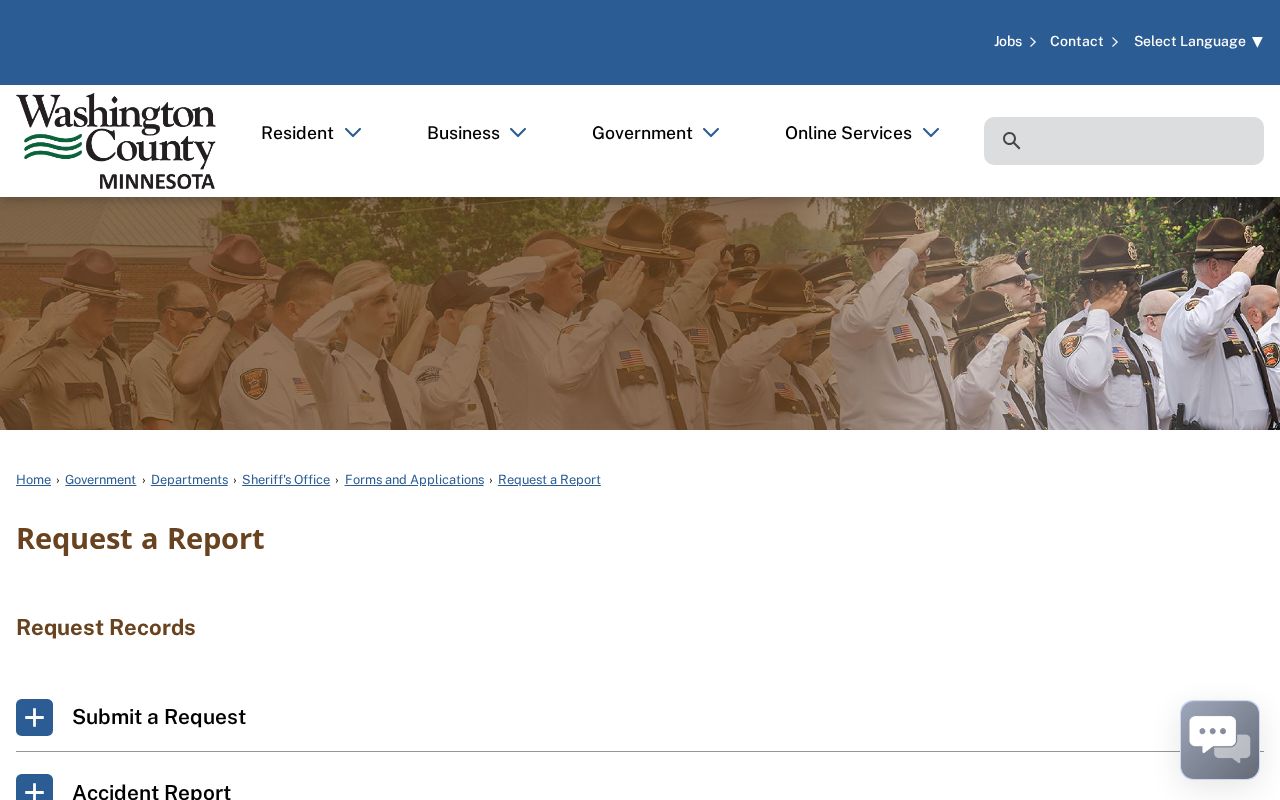
Washington County charges $1 per 10 pages for reports. Requests are handled in order and can take up to 10 business days.
Comparing Arrest, Summons, and Bench Warrants
Three documents can bring a person before a judge in Washington County, each with different weight. A summons asks. An arrest warrant compels. A bench warrant answers something that already went wrong in a pending case.
| Point | Arrest Warrant | Summons | Bench Warrant |
|---|---|---|---|
| What it responds to | A charge supported by probable cause | A charge, used instead of arrest | A missed date or a violated order |
| What it asks for | Arrest and appearance | Appearance on a set date | Appearance or compliance |
| Typical first step | Custody and booking | A court date without custody | A new date, a payment, or a recall |
| Who acts on it | The sheriff or any officer | The person named | The person named, or an officer if it escalates |
The missed-date path gets fuller treatment on the Washington County bench warrant page.
The Sheriff's Records Portal, Step by Step
Washington County takes law-enforcement records requests through NextRequest. The portal covers sheriff's data, not general county records. A new requester can start without an account; entering an email sets one up. The portal itself sits at the WCSO NextRequest public records portal.
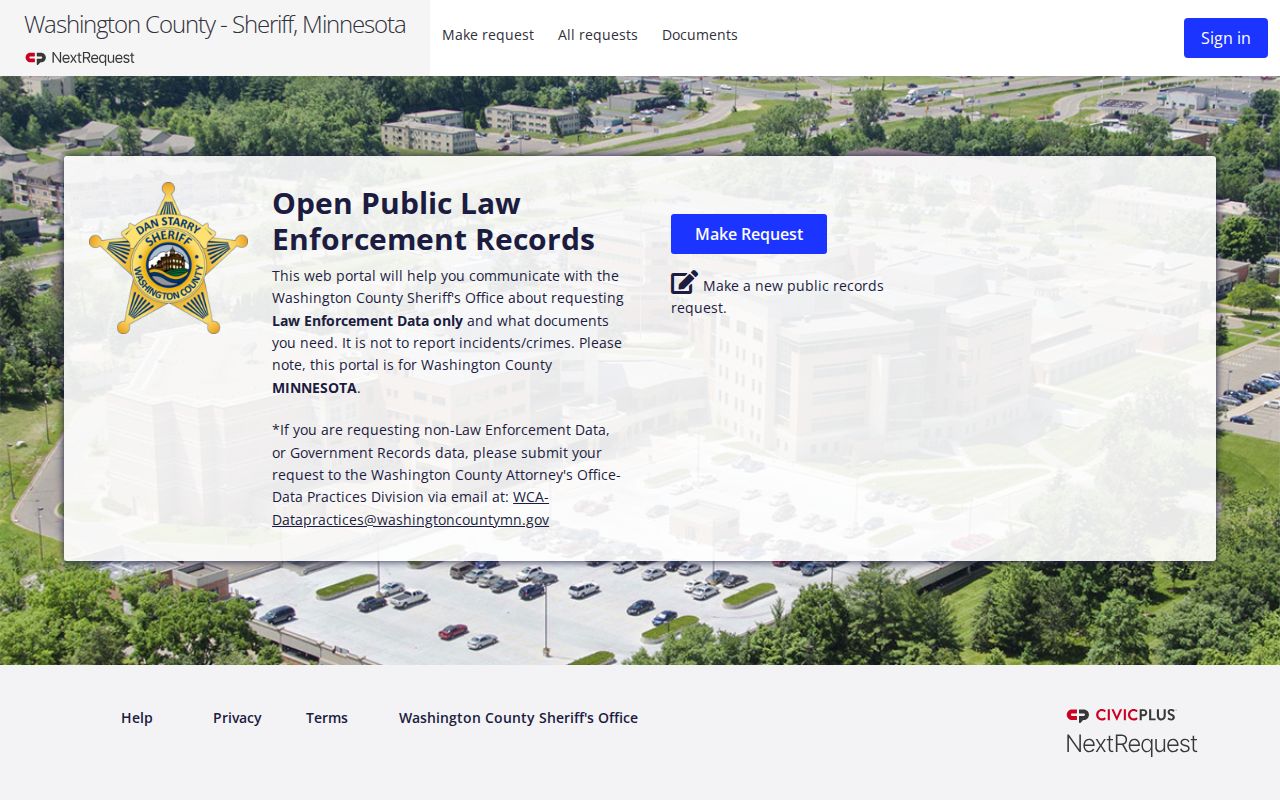
The Washington County portal accepts fax, email, in-person, phone, web, and mail delivery, and it keeps each request and response in one thread. Returning users sign in at the NextRequest sign-in page.
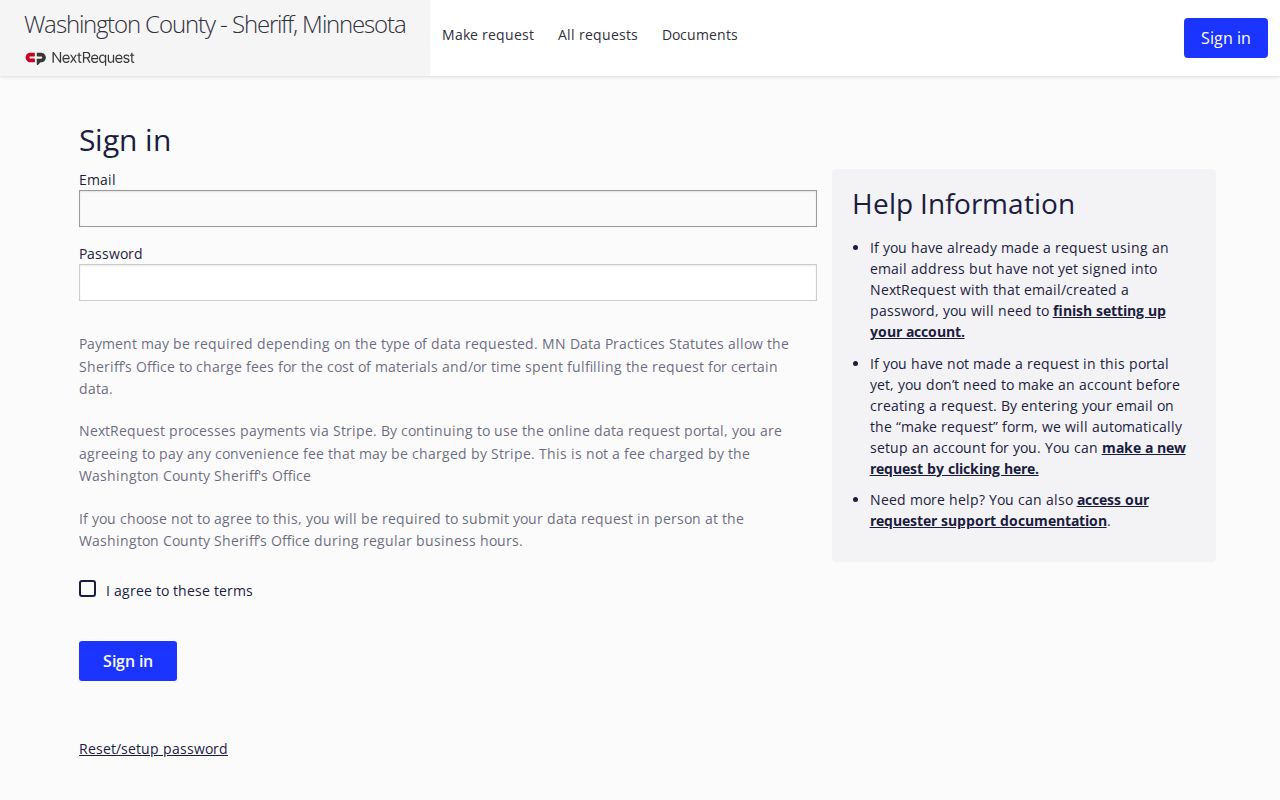
Signing in with an email and password accepts the portal terms. Card payments may carry a convenience fee.
If There's an Arrest Warrant for You
Confirm the warrant first. Then call a lawyer. Washington County warns residents not to act on a website result, and an arrest warrant is the kind that can land a person in custody at a traffic stop or during a jail booking on an unrelated matter. The realistic paths are a voluntary surrender, posting bail, or a motion asking the court to recall the warrant. For a surrender, the county's instruction is a 5:45 a.m. arrival at the jail window on a non-holiday weekday. A same-day docket is not guaranteed.
Talk to an attorney first. Bail applies only to a person in custody, and paying a fine does not clear an arrest warrant on its own.
Arrest Warrants Travel Statewide
A Washington County warrant does not stay inside county lines. Minnesota Rule 3 lets a district judge issue a warrant that can be executed anywhere in the state, and state law addresses apprehension beyond the originating county. Even so, execution scope is set warrant by warrant. The archived form allows Minnesota-only, border-state, or nationwide service, so ask the issuing court which one applies rather than assuming. Federal warrants sit outside all of this. They come from the federal court system, are handled by agencies such as the U.S. Marshals Service, and will never appear in this county's lookup.